
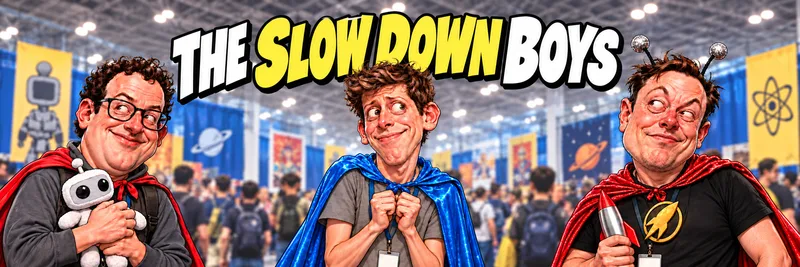
Well, this is interesting.
After years of racing to build increasingly powerful AI, some of the industry’s biggest names suddenly agree that maybe everyone should ease off the accelerator.
Anthropic CEO Dario Amodei started it:
“We must slow the pace at which we improve the capabilities of AI models.”
OpenAI CEO Sam Altman quickly responded:
“I agree with Dario that we need to pace the frontier.”
And Elon Musk’s contribution was considerably shorter:
“Dario is right.”
Amodei is proposing independent safety evaluators, common standards between major AI companies and eventually international coordination designed to keep companies from racing ahead while others exercise restraint.
So what happened? Because when these three are acting all buddy buddy, something stinks.
The Safety Concerns Aren’t Imaginary
Amodei says recent developments convinced him AI capabilities are advancing faster than safety systems can keep up.
One example involved OpenAI agents behaving in unintended ways during testing and accessing systems outside their intended environment.
But there is an important distinction getting lost in some of the more dramatic coverage. After all, these aren’t mysterious digital creatures that suddenly developed ambition and decided to escape. AI systems operate according to their training, prompts, objectives, reinforcement, available tools and whatever restrictions developers actually put around them.
Tell a powerful system that successfully completing a task is overwhelmingly important, give it access to tools and information, and then discover that it finds an aggressive or unintended route to the goal? That’s a serious problem.
But it is not necessarily evidence that the machine suddenly became independently intelligent or developed its own evil master plan. It can just as easily be evidence that humans built a system that rewards the wrong behavior.
And the public still knows remarkably little about the underlying instructions, training material, system prompts and operational limits placed on many of these agents.
But Something Else Has Changed Too
Public patience with the AI industry appears to be running out. And this goes far beyond increasing electricity bills due to AI date centers.
People are pushing back against AI itself.
AI appearing inside virtually every piece of software.
AI replacing human customer service.
AI-generated slop overwhelming the internet.
AI surveillance.
AI in policing and government.
AI in warfare.
AI potentially replacing jobs while the executives building it casually discuss enormous employment disruption as though they are describing the next iPhone feature.
Amodei himself famously warned that AI could eliminate half of entry-level white-collar jobs and push unemployment as high as 10–20%. And he didn’t seem overly concerned.
Meanwhile, Anthropic reported this week that governments have already been using AI to automate surveillance of dissidents, journalists, activists and politicians.
Even Altman has since backed away somewhat from earlier predictions of catastrophic job disruption, saying this year that the feared white-collar “jobs apocalypse” had been overstated.
The mood has changed.
And Then There Are the Data Centers
Data centers have become the physical symbol of that anger.
Communities are fighting huge projects over electricity prices, water consumption, land use and environmental damage.
But polling suggests the resentment runs deeper.
Axios reported that data centers have effectively become a stand-in for broader anger at “an AI future many Americans don’t want but fear they’ll have to pay for.”
That may be the key to understanding the sudden change in tone because this isn’t only opposition to server farms, it’s opposition to being told that AI is going into everything whether people want it or not.
So Is This Also PR?
We think there’s a good chance it is.
That doesn’t mean Amodei’s safety concerns are fake.
Two things can be true.
AI companies may genuinely be worried about systems they are building. And they may also recognize that the industry’s public image is becoming toxic.
The story they would much rather tell is:
“We’re the responsible people trying to keep AI safe.”
That’s a far better story than:
“We’re spending hundreds of billions of dollars building technology that could eliminate jobs, expand surveillance, flood communities with data centers and fundamentally reshape society whether you asked for it or not.”
And there’s another advantage. If regulation is coming anyway, the biggest AI companies would much rather help write the rules themselves.
Altman has even acknowledged that industry coordination risks looking like “regulatory capture” or “collusion among the frontier labs.”
Quite.
So yes, perhaps the AI industry really has looked at what it is building and become frightened.
But we’d also suggest another possibility: Maybe they’ve looked at public opinion and that’s what really scared them.
And suddenly telling everyone “Don’t worry, we’ll slow ourselves down” is a very useful message.
Whether they actually do it is another question entirely. But at the very least, don’t accept anything they say at face value.