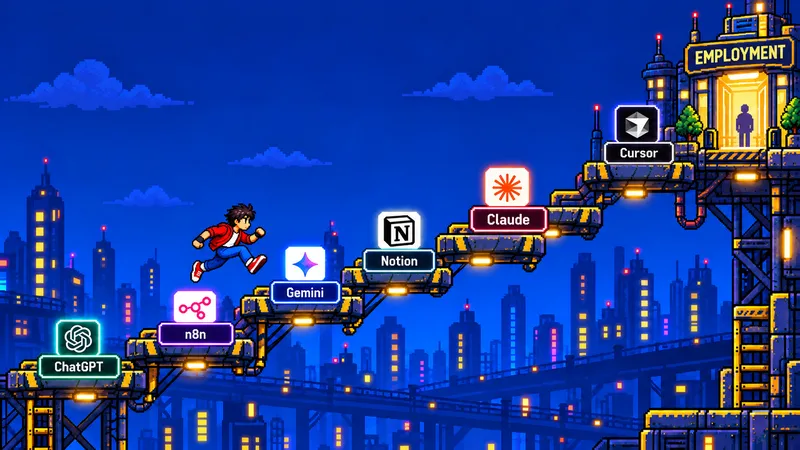
AI is moving from a nice-to-have skill to an actual job requirement. New research suggests employers increasingly want marketers who can build workflows, automate tasks, and do more than ask ChatGPT to write another LinkedIn post.
Remember when knowing how to use ChatGPT was enough to impress a potential employer? Well, those days might be numbered.
According to a new study from marketing education company CXL, 40% of the US marketing job descriptions it analyzed in Q3 2026 required AI skills, compared with just 15% in Q1. Yep, that’s nearly a three times increase in less than a year.
CXL examined 2,126 LinkedIn marketing job descriptions across the three quarters, including 878 in Q3. The results suggest that AI is quickly becoming part of the everyday marketing job description.
The Numbers Tell the Story
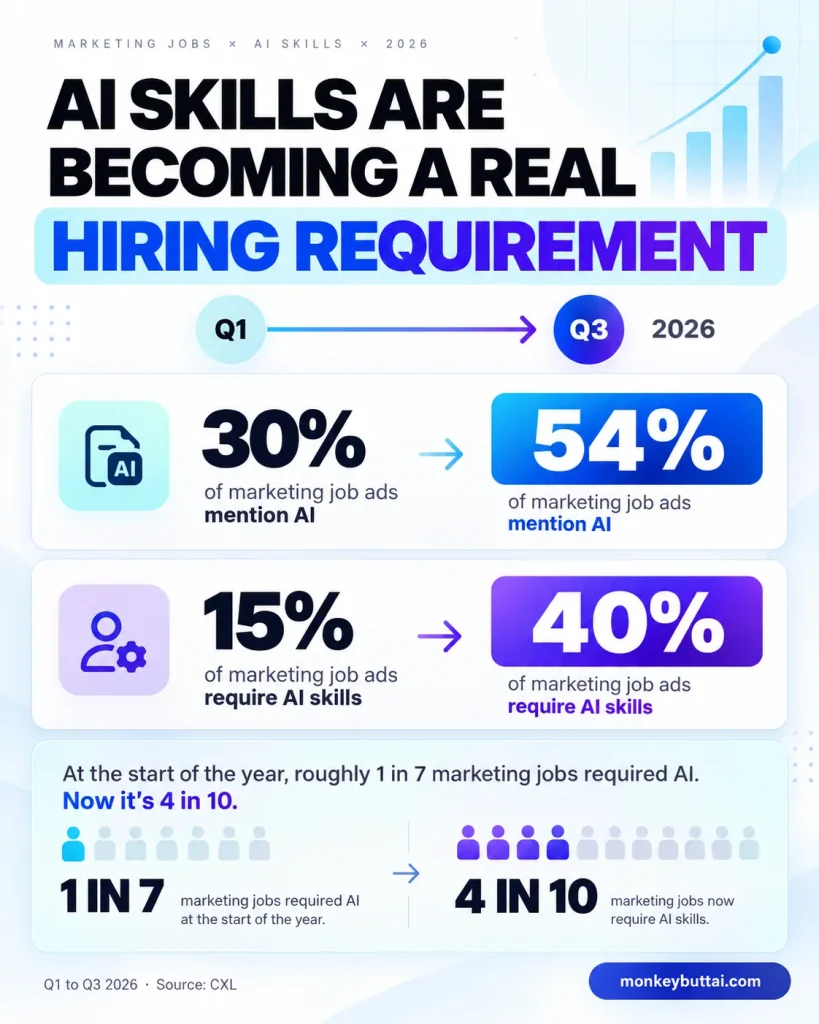
CXL’s findings reveal how quickly hiring expectations are changing:
| AI in marketing job descriptions | Q1 2026 | Q3 2026 |
|---|---|---|
| Mention AI | 30% | 54% |
| Require AI skills | 15% | 40% |
| Mention automation | 18% | 35% |
| Mention AI agents | 3% | 8% |
| Mention AI search (AEO/GEO) | 6% | 15% |
Some marketing specialties are moving even faster. In Q3, AI skills were required in 56% of conversion rate optimization and experimentation roles and 54% of growth marketing roles examined.
The changes aren’t limited to entry-level employees, either. Among senior and lead positions, AI requirements rose from 20% in Q1 to 49% in Q3.
One important qualification: these figures come from CXL’s samples of US LinkedIn job listings, not a census of all marketing jobs. They shouldn’t be treated as worldwide hiring statistics.
Knowing ChatGPT Isn’t the Same as Knowing AI
There’s a difference between using AI to complete a task and understanding how to make it part of a working system. And increasingly, employers appear interested in the second.
CXL found growing references to workflow automation and tools such as Claude Code, Cursor, n8n, and Clay. This makes sense as much of marketing is about creating the right flow across multiple departments.
Instead of simply generating social media captions, marketers may be expected to connect tools, automate repetitive work, and turn raw data into useful insights. It’s about the whole, not speeding up a single part.
This could include automated performance reports, campaign creation systems, or workflows that turn one piece of content into assets for several platforms.
Prompting is no longer the whole skill set. Increasingly, employers want to see how AI can fit into a practical workflow.
It’s Not Just One Company’s Research
The wider job market is showing similar signals.
In June, LinkedIn reported that marketing job postings requiring AI literacy had increased 113% year over year.
Meanwhile, the American Marketing Association’s 2026 State of Marketing Careers Report, which surveyed 1,412 marketing professionals, identified AI fluency as an increasingly standard workplace expectation.
But remember, AI is not enough: AMA also highlighted that critical thinking, creativity, communication, and sound judgment remain essential. Why? Because as powerful as these systems can seem, they still require the intelligence, wisdom and perspective only a human can provide.
Yes, AI can generate an entire marketing campaign in minutes. But knowing whether that campaign is accurate, appropriate, or any good still matters.
So What Should Job Seekers Actually Learn?
The research suggests a useful shift in how marketers approach AI training.
Rather than trying to master every new tool, it’s important to focus on building something you can demonstrate.
For example:
- Build a content workflow: Turn one approved campaign brief into coordinated social posts, email copy, and other marketing assets.
- Create a reporting system: Use AI to analyze sample campaign data and produce a weekly performance summary.
- Automate a repetitive task: Connect existing tools to reduce manual work, while keeping human approval where it matters.
Document what you built, how it works, and what problems it solves. Test the output, check the numbers, and demonstrate the results.
Your resume is only as good as your portfolio!!!
Looking for opportunities to put those skills to work? Browse the MonkeyButtAI AI Jobs Board for current openings, including roles at AI-focused companies.
The Last Word
The interesting change isn’t that more employers are mentioning AI. It’s that they’re becoming more specific about what they expect people to do with it. And while the CXL findings don’t establish that 40% of all marketing jobs require AI, the direction is supported by other industry research.
The next time a potential employer asks about your AI experience, having a working project to show them beats saying you’re really good at writing prompts.
Every. Single. Time.
Sources
- CXL — Marketing Hiring Trends 2026: The Skills Employers Want in Q3 — October 9, 2026
- LinkedIn — AI Skills Initiative for Marketing Professionals — June 16, 2026
- American Marketing Association — 2026 State of Marketing Careers Report — July 31, 2026